
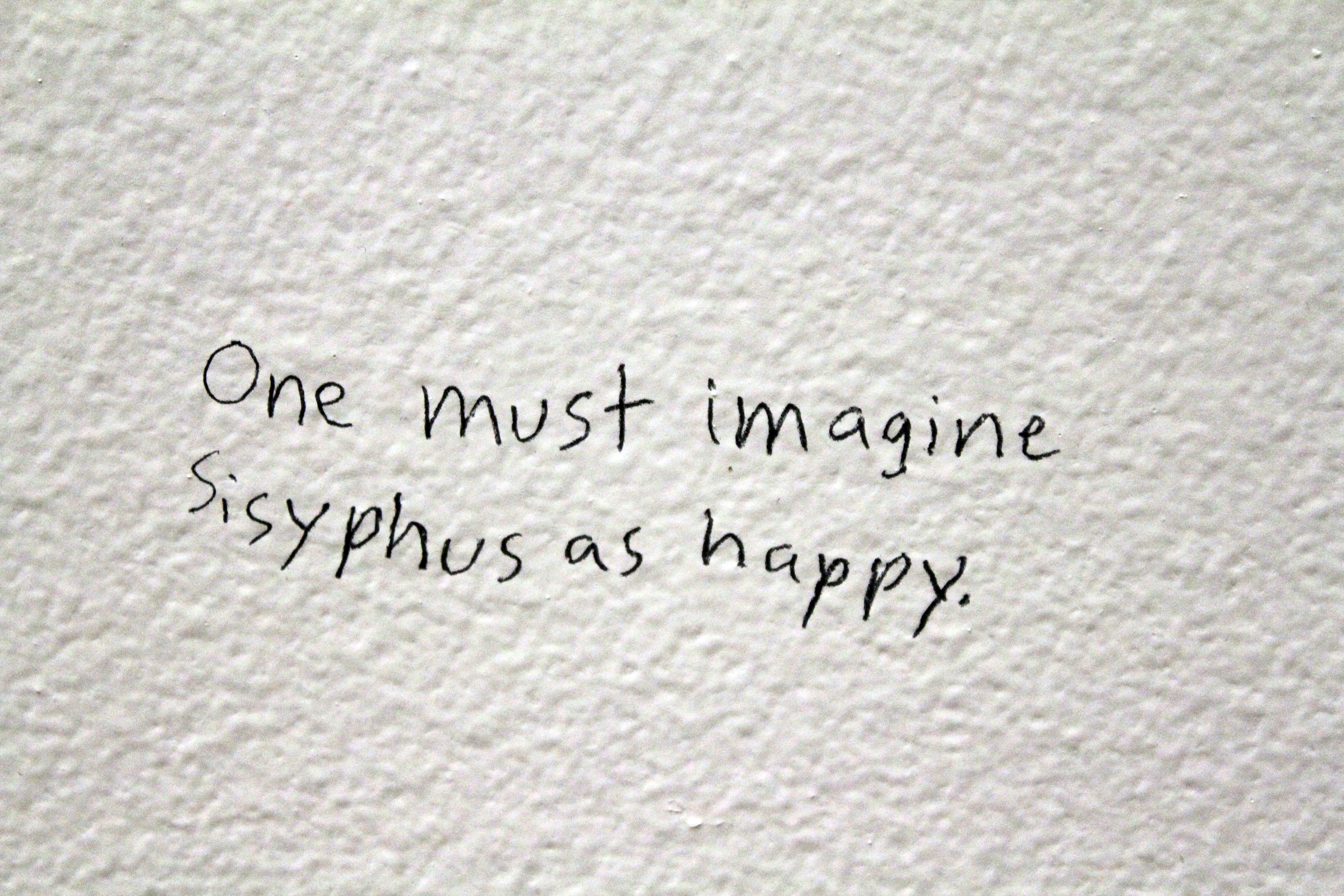
One must imagine Jewish Sisyphus happy
This is meta

We’re back!
Housekeeping notes: This past Monday, paid subscribers got this month’s ET Read Home, a monthly book club of sorts. I wrote about Primo Levi’s The Wrench. I realized after sending it that this was supposed to be the second paid feature of the month and that I gave anyone who wants to read it about 11 seconds to do so between announcing the book and writing the essay. I apologize and hope that this doesn’t discourage anyone from reading The Wrench.
With that! Onto news, views, and Jews.
NEWS
For the Forward, I wrote about cognitive dissonance, American Jews, and the future of Israel and the Democratic Party.
If you have 90 minutes of this one precious life that you’d like to spend on watching me moderate a panel on the last 250 years of American Jewish history and the history of American Jewish Studies, this link is for you.
From the Guardian: “Iran has spurned two messages from Donald Trump’s special envoy, Steve Witkoff, seeking a ceasefire as its leaders sense it is not losing the war and the US president is at the minimum feeling the political pressure.”
The New York Times has a quiz that shows whether you prefer writing by humans or AI. (I preferred human writing, which is a relief for me, the human writing this). I do have to object to one thing, though, which is that the results offered, “You’re either sharply attuned to the qualities that make for great writing, or a lucky guesser. Maybe you also noticed that human writing often includes some clunky phrases, like this passage from Cormac McCarthy’s ‘Blood Meridian,’ caused by the author’s aversion to punctuation: ‘As well ask men what they think of stone.’ A.I. used to make mistakes like these. But today’s systems are much more fluid than their predecessors — so fluid, in fact, that finding grammatical errors or nonstandard syntax is often a hint that you’re looking at a human’s prose, not a machine’s.” These aren’t “mistakes.” They’re style and voice and taste. I know there’s no way to write the following without sounding old, but: We used to recognize that differences and frictions aren’t imperfections to be optimized, but signs of distinction. That maybe they’re even the markers of art. Now we call them errors.
MY VIEWS ON…
…finding the point at this particular moment!
There is a line from Lord of the Rings (the movie; I haven’t read the books because I tried as a child three times and got stuck each time in the part of The Hobbit where they’re sitting in trees chanting at birds) that goes, “The hour is later than you think.” I’ve been thinking about that a lot. I think I would reply, “No, I understand it’s very late.”
What I mean by that is this:
“Could this be a religious war designed to rebuild the Third Temple on the ashes of Al Aqsa?” asked Tucker Carlson. “Hope not.”
It is very easy to criticize this war, and even the US-Israel relationship and how it impacted Trump’s decision to go to war, without saying a version of, “Are we losing American troops to the strange Jew magic?” And yet Tucker Carlson appears to repeatedly choose option B.
This is, to my mind, very clearly antisemitic, overassigning agency to Jews (who, as I’ve noted before, Carlson represents as somehow immutably Other) and stripping it from others (like, say, the US president). I don’t feel wrong or silly saying so. I think saying so is right and correct.
I also know, however, that I am saying so in a country in which things that are not antisemitic are deemed as such in order to chill criticism of US policy toward Israel and Israel itself.
The ADL, for example, in its post about antisemitism and the war against Iran, said, “Rhetoric that solely blames the Jewish state or frames American policy as manipulated by Jewish influence is not just indisputably false, it echoes some of history’s most dangerous antisemitic tropes,” which I think I more or less agree with, but said so only after offering, “Labeling Israel as an ‘apartheid state’ or accusing it of ‘genocide’ are not acts of responsible policy critique. The charges are inflammatory, factually inaccurate, and play directly into efforts to delegitimize the Jewish state and inflame hatred.”
Leaving aside that that isn’t really about the war with Iran: I do not think that our most prominent antisemitism watchdog lumping “legal definitions that the ADL does not think should be applied here” and “conspiracies about a Jewish cabal” together under the banner of “antisemitism” is useful to having antisemitism understood or taken seriously, any more than its push to conflate anti-Zionism with antisemitism, or the insistence of many Jewish institutions, and for that matter many Jews, that Zionism is Judaism is Zionism, has been productive or honest or helpful. (After I drafted this, the ADL condemned New York Mayor Zohran Mamdani for having iftar dinner with Mahmoud Khalil, the pro-Palestinian protester the Trump administration detained/caused to miss the birth of his child/is trying to deport for allegedly posing a national security threat, which is actually a clearer example of what I am describing.)
None of that absolves Tucker Carlson. None of that absolves, say, the people shooting at synagogues in Toronto (linked to in the section below). I am just trying to articulate that antisemitism, as far as I can tell, is getting worse, not better, and that calling anything and everything to do with Israel “antisemitism” has, in addition to not stopping it, has helped create a situation where the general population is basically wary that the term is anything but a political weapon. The problem is getting worse; the conditions contributing to the problem are continuing; people care less.
I spend much of my time writing and thinking and speaking against use of Jewish identity by Jewish organizations and various governments to chill speech and criticism, and also against antisemitism, and both continue apace. It’s narcissistic to think that any writing, let alone my writing, would change anything, but it’s also dispiriting to see both trends continue, if not worsen, even as in my more optimistic moments I think that at least some people are seeing both trends more clearly. All of which is a way of saying: The hour’s late and I know it.
On the other hand: What’s the other choice? To accept that things are bad? To say we’re too far gone so—what? What are we to do with that, except to keep trying anyway?
Yes, things are bad. Yes, we’re very far gone. But, as I recently joked online, one must imagine Jewish Sisyphus happy. It’s impossibly late. Here we are, awake all the same.
AND SOME STUFF ABOUT JEWS
It’s not funny at all but I laughed that the headline of this Gideon Levy Haaretz column: “Everyone in This Country Has Gone Insane”
To me the most interesting thing about this poll on US Jews and war with Iran is the decision to poll “connected” Jews and how that is defined.
From the Toronto Star: “In a week that saw three Toronto-area synagogues hit with gunfire — two within minutes of one another — police say they are increasing their presence and surveillance around Jewish neighbourhoods and places of worship.”
From France 24: “Belgium’s prime minister vowed to combat antisemitism on Monday, after a pre-dawn blast damaged a synagogue in eastern Belgium, with prosecutors in charge of organised crime and terrorism heading up the investigation.”
From RNS: “Forbidden love finds a way in new memoir about Israeli-Palestinian couple”
From the Forward: “Hundreds of observant Jews convened at a Manhattan synagogue on Sunday to foster an alternative to the prevailing right-wing discourse about Israeli and American politics in the Orthodox world. But the conference also surfaced uncomfortable arguments within the dissent, with some attendees walking out of one session in protest.”
From JTA: “At first glance, “Papillon” (Butterfly), the 15-minute Oscar-nominated animated short by veteran French filmmaker Florence Miailhe, may appear like a meditative journey through water and memory. An elderly man swims in a hand-painted sea, flashing back to childhood memories of being bullied and a loving mother who makes it all right. As he cuts through the water and moves through time, the fuller context emerges: The sun-soaked beaches appear to be North Africa, the boy becomes a champion swimmer, a swastika tells you that he is competing in the 1936 Berlin Olympics, and the soundtrack echoes with taunts of ‘Jew’ and ‘kike.’ The film is based on the extraordinary real life of Alfred Nakache, a Jewish athlete whose story of resilience under Nazi persecution has previously been told in two French documentaries but is seldom remembered today.” You can (and indeed should) watch the short film here.
I also want to watch this new documentary about Greek Jews and 20th century history.
-ET
"Sisyphus" by quinn.anya is licensed under CC BY-SA 2.0.