
On biographies
And history and gossip and the news and

We’re back!
Housekeeping notes: This week, paid subscribers got this month’s ET Speak Home, a monthly mini-interview.
With that! Onto news, Jews, and views.
NEWS
From the Washington Post: “To repair ties with India, Rubio leans into pageantry”
From the AP: “Hungary’s Magyar vows to probe alleged misconduct by Orbán’s government”
I love this website that suggests a Rothko for the weather where you are. It feels like something from the internet of 2014 and I mean that as a high compliment.
A friend who is my mom sent me this New York Times article on a rare pasta in Sardinia and described it as “a wild story.” It really is!
I don’t know that anyone comes here for sports content but here are three Premier League winner Arsenal pieces I liked a lot: this Athletic profile on Mikel Arteta and his connection to the club; this New Yorker newsletter item by Arsenal superfan Ishaan Tharoor; and this Financial Times column on how it became the club of the “streets and elites” around the world.
I found this letter from Elina Svitolina to her daughter about her husband and daughter’s father, Gaël Monfils, quite moving (and also pretty funny). And this Louisa Thomas New Yorker profile of Svitolina is predictably wonderful. I really love how she writes about tennis and tennis players. You don’t need to be a superfan of the game or even to have picked up a racket in, say, 25 years to understand exactly what it is she’s saying.
MY VIEWS ON…
…biographies!
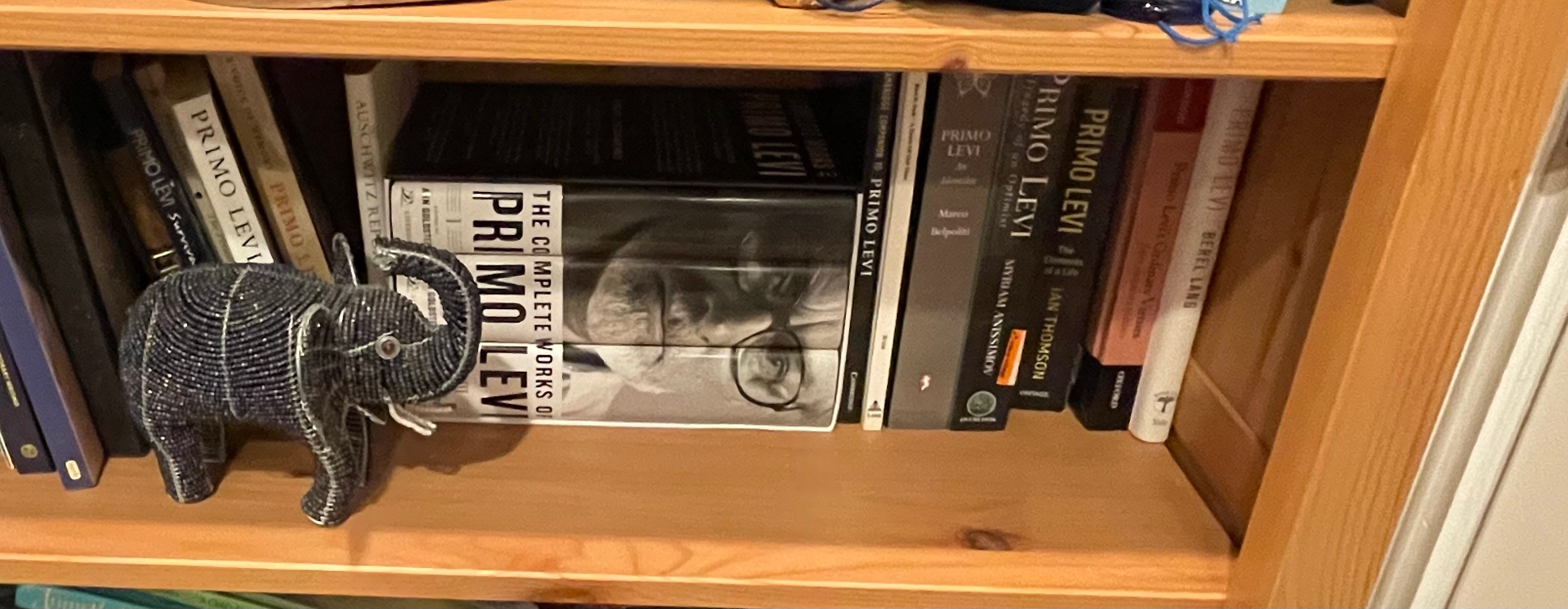
This weekend, I read the fifth book that could conceivably be described as a biography of Primo Levi. I couldn’t really tell you why. Let’s move on.
The first one, by Berel Lang, was the one from the Jewish Lives series. I loved it (I actually wrote Lang a fan email but got no reply and it makes me sad that, since he passed away a few months later, I’ll never know whether he read it) but, at 150 pages, it’s more of a series of sketches in profile. I read Ian Thomson’s Primo Levi: A Life, which is the most straightforward and comprehensive and the least “about” Jewishness and, this past weekend, Myriam Anissimov’s Primo Levi: Tragedy of an Optimist, which is also basically a straightforward biography and also the most concerned with explicitly Jewish issues and elements. I’ve also read Robert S.C. Gordon’s Primo Levi’s Ordinary Virtues: From Testimony to Ethics, which is sort of a biography of values, and Marco Belpoliti’s Primo Levi: An Identikit, which I would describe as a biography through Levi’s works. I’m not sure if the book makes much sense if you haven’t read a lot of Levi, but if you have, it’s exquisite. (Yes, I also wrote Belpoliti a fan email; no, I didn’t get a reply to that one, either. If anyone reading this happens to know him, please tell him Emily Tamkin loved his book, and when he says, “who?,” just nod knowingly.)
Primo Levi only lived 67 years. His life was, all things considered, pretty recent. What I mean to say is that his life was not all that long ago and not all that long. The facts are not really in dispute and there are only so many facts to cover. And yet the biographies vary widely and wildly. What role did Auschwitz play in his suicide all those years later? What did Jewishness mean to him? What about Israel? What about women? His wife? His mother? I’ve said that some of the best journalistic profiles of individuals don’t actually include interviews with them, because the most revealing quotes about a person are rarely said by the person. I mostly stand by this, but I think that this means that I basically don’t think the content of a person’s biography has much to do with what they think it should say. But then who determines it? The biographer, who is, in many cases, a total stranger to the subject, and who wasn’t there for the events themselves.
This isn’t a particularly profound or novel thought—different people interpret and present different facts differently, news at 11—but I kept thinking about this, and so am inviting you to think about it, too, not only because it’s worth keeping in mind any time you read a biography. Even the most straightforward biography is an interpretation. (I say this having written a biography, albeit one that makes clear, or tries to, in its introduction that it is less about a man than the idea of him.)
If this is true about different presentations of this one person, it’s also surely true of everyone and everything else in history and even in the news. Not to be too Tumblr about this but it’s true when you think about yourself, too. I think maybe, for example and with some exceptions, it’s worth thinking of anecdotes about yourself that don’t align with how you think of yourself as one of your biographies: an interpretation of agreed upon facts that may or may not reflect how it really was or who you really are.
I don’t mean that there’s no real truth. There are certain things that happened and certain things that didn’t. But there’s no one way to perceive or present them. Which means that, when we read or take in information, we need to both take it and its lens in. Even if that information is just about Primo Levi’s life, again.
…AND SOME STUFF ABOUT JEWS
From Haaretz: “Likud Minister May Golan lashed out at Reform rabbi, MK Gilad Kariv of the opposition’s The Democrats, in the Knesset on Wednesday, accusing him of ‘marrying dogs in your delusional synagogues.’” Woof woof, lady.
A recent GBAO survey of Jewish voters showed 83 percent do not feel a political candidate’s insufficient support of Israel to be a dealbreaker; over half believe Trump is antisemitic; two thirds have an unfavorable view of Netanyahu; and, most remarkably, that 24 percent support replacing Israel with a binational state.
In Jewish Review of Books, Benjamin Balint on Franz Kafka, Martin Buber, and Paul Celan: “Sinai before Switzerland: Three Dialogues in the Mountains”
From Jewish Insider: “Wexner Foundation to spin off North American leadership programs into new nonprofit”
This “Andrey X” Haartez profile is fascinating as much from a Russian politics perspective as anything else.
From the Forward: “Park Slope Food Coop battle spills into politics and pulpits ahead of long-brewing boycott vote” (Update: It passed)
In his Substack, Shaul Magid has a thought provoking essay on original sin, Zionism, and interpretations of the Balfour Declaration.
-ET